Healthcare has made real progress during the encounter. Documentation is more standardized, diagnostics are more precise, and clinical protocols are better defined. In many settings, the quality of decision‑making at the bedside is higher than it has ever been.
And yet, outcomes remain stubbornly unstable.
Readmissions continue. Emergency department utilization remains high, and families describe care as confusing and exhausting. Clinicians often feel they are reacting later than they should, even when they are doing everything right within the scope of the patient visit.
The problem is typically not what happens during encounters. It is what happens between them.

The hardest part of modern care isn’t decision‑making. It’s seeing enough, early enough, to make the right decision stick.
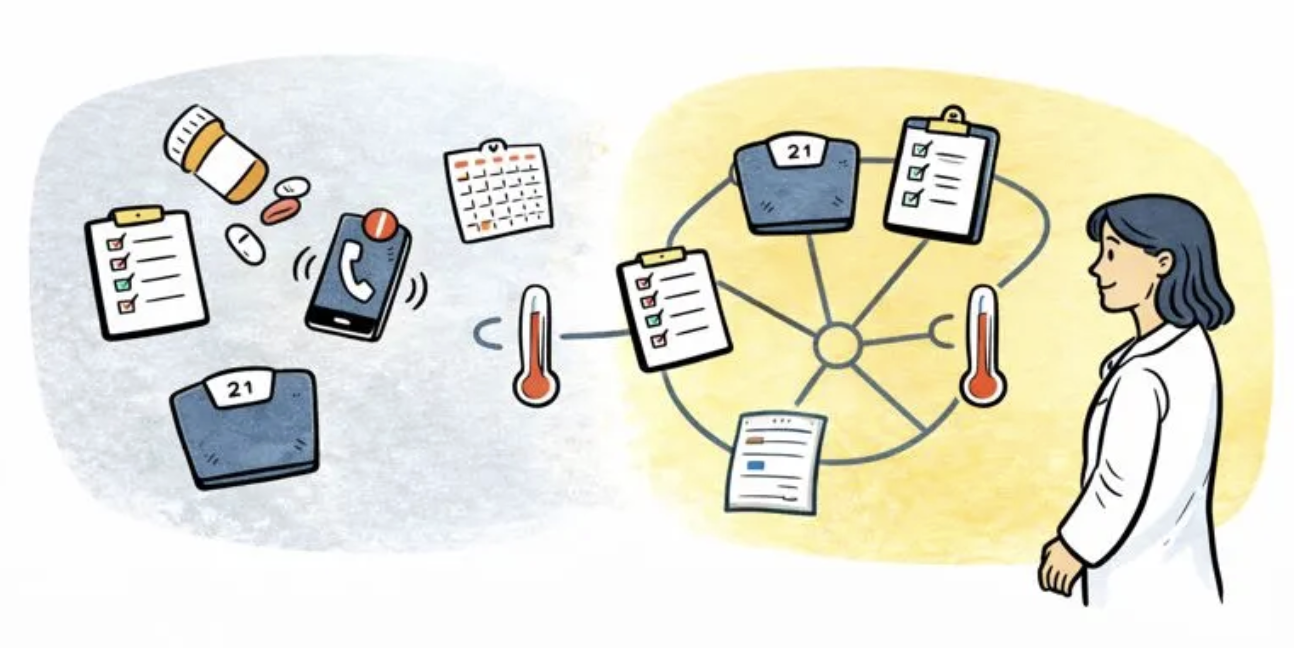
Modern care is no longer episodic, even if our systems still behave that way. Most clinical risk develops gradually, outside the exam room, in the long stretches of time when no single clinician is “with” the patient, but everyone is still responsible for what happens next.
Risk rarely announces itself in healthcare. It builds quietly, through small deviations that feel manageable in isolation but meaningful in combination. A medication change that does not fully propagate across settings. A refill delayed because no one clarified the new regimen. A follow‑up appointment rescheduled once, then again, without anyone noticing the pattern. A home health observation documented but never contextualized. A family member who mentions, almost in passing, that something feels off.

None of these signals is an emergency on its own. Clinicians encounter versions of them every day. The problem is not their existence, but their separation. When these details live in different systems, different inboxes, and different conversations, no one sees the trajectory forming. By the time the patient presents to the emergency department or requires readmission, the situation feels sudden. In reality, the warning signs were there all along, just never assembled in time to change the outcome.
A striking part of this pattern is that the signals themselves are rarely complex. They are often simple, everyday indicators — small weight changes, shifts in appetite or hydration, missed medications, subtle mobility decline, early wound concerns, social barriers like food or transportation challenges, or a family member’s sense that something is off. None of these is dramatic on its own. Their significance comes from being seen together, in time, before they harden into crisis.
Across conditions, the same pattern repeats itself:
These are not failures in isolation. They become failures because the system never assembles them into a coherent story early enough to act.
This is not a failure of clinical competence.
Across hospitals, clinics, home health agencies, and specialty practices, clinicians are doing their jobs thoughtfully and responsibly. Decisions are grounded in evidence. Documentation is largely complete. People are working hard. What is missing is not effort, but alignment over time. Each part of the ecosystem sees a slice of the patient’s story. Very few see the whole arc as it unfolds. Decisions made in one setting often land in another without context. Adjustments intended to help in the short term quietly create instability downstream. Good medicine ends up being practiced on partial information.
You can see this most clearly in everyday scenarios.

Heart failure. Small weight changes, missed diuretics, or subtle increases in shortness of breath often precede admission by days or weeks. Those signals exist, but they are scattered across home scales, pharmacy systems, home health notes, and family observations. No one sees the pattern until the patient decompensates.
Oncology. Fatigue, pain, or missed visits frequently surface informally before they become acute. Without shared visibility, the first true escalation often happens after hours, in the emergency department, when outpatient intervention would have been safer, less disruptive, and more humane.
Post‑surgical recovery. Missed physical therapy, confusion about medications, or early signs of infection often appear well before complications are diagnosed. When those signals are not connected, patients return to the hospital not because the complication was unpredictable, but because it was never assembled into a meaningful trajectory early enough to intervene.
In each case, the system does not fail because clinicians did not care. It fails because no one was structurally responsible for holding the story together between encounters.
We often talk about continuity as a value, something teams should aspire to, or families should hope for. That framing misses the point. Continuity cannot depend on heroics. It cannot live in spreadsheets, phone calls, or the memories of overextended staff. It has to be built into the system itself.
When continuity is treated as infrastructure rather than effort, a quiet but meaningful shift occurs. Medication lists stop drifting across settings. Care plans stop diverging without anyone noticing. Family concerns surface as clinical context rather than background noise. Most importantly, risk becomes visible early enough for intervention to be quieter, simpler, and far less expensive.
This does not change how clinicians practice medicine. It changes when they can act.
Clinicians do not need more alerts, portals, or dashboards. They need to trust that the information in front of them reflects reality. They want to enter an encounter knowing that recent changes are visible, that observations from home matter, and that decisions made elsewhere will not be hidden or contradicted. When that context exists, clinical judgment becomes more confident and less defensive. Time shifts away from reconstruction and toward care.
Care managers experience this shift just as clearly. Instead of spending their days chasing documents and reconciling discrepancies, they can focus on stabilizing trajectories before they break. Families stop acting as the system’s backup memory. Operators stop discovering risk only after it has already turned into avoidable utilization.
Healthcare is slowly, but unmistakably, moving toward accountability beyond the encounter. Value‑based contracts, bundled payments, and shared‑risk arrangements all assume something that has not historically been true: that organizations can see and manage risk as it forms, not just explain it after the fact. This is the difference between managing risk retrospectively and preventing it prospectively.
Without continuity infrastructure, accountability collapses into heroism and hindsight. Clinicians carry responsibility without visibility, families carry burden without support, and leaders chase outcomes that were never operationally possible to control.
With continuity infrastructure, accountability becomes realistic. Risk is addressed earlier. Escalations are avoided rather than explained, and outcomes stabilize not because care is restricted, but because the system finally supports timely, informed action.

The most meaningful changes rarely arrive with fanfare. They show up as fewer late‑night calls, fewer emergency visits driven by uncertainty, and fewer moments where teams ask how something was missed. They show up as care that feels calmer and more predictable because it actually is.
Continuity, when built in, changes the conditions under which care happens. And when those conditions change, outcomes follow.
Need a hand? Not sure where to start?
We're here and happy to help. Drop us a line and we'll get back to you or call Support at (877) 694-4431.
We also have tons of articles and videos on our help page for many frequently asked questions.
Privacy is important to us, so you have the option of disabling certain types of storage that may not be necessary for the basic functioning of the website. Blocking categories may impact your experience on the website. More information


