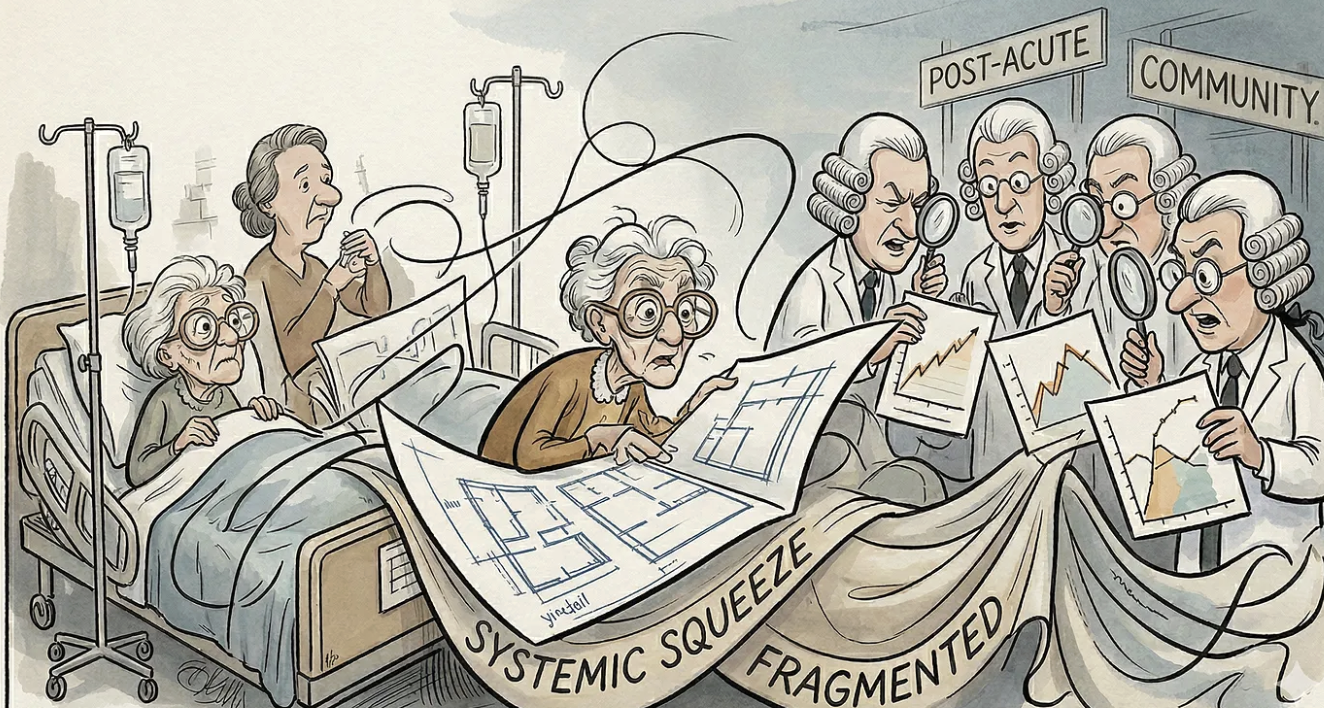
When I first began writing about my health tech journey, I was writing from conviction. I had stepped away from a structured and successful professional path because I could not “unsee” what I had witnessed in my own family. Over more than a decade, three close relatives declined along very different clinical paths, yet the experience of navigating their care felt remarkably similar. Fragmented. Bewildering. Exhausting. Even with five physicians in the family, deep networks, and financial stability, care management was excruciating. It forced a question that still guides me today: if it was this hard for us, what must it be like for families without those advantages?

Those early essays were about recognizing the windmills and accepting that the problem was real.
As I spent more time inside the healthcare ecosystem, my tone shifted. By the time I wrote Don Quixote Had It Easy, I had learned that the barriers were not simply technological. They were structural. Staffing shortages were systemic. Payment reform was slow and uneven. Incentives were layered and often contradictory. Nearly everyone I spoke with agreed that a more connected, community-centered model was needed, and nearly everyone also acknowledged how monumental it would be to build.
That phase of writing was about endurance and continuing forward even when the system seemed immovable.
But the windmills have taught me something harder and more precise. The barriers to better care are not built of indifference. They are built on incentives. And incentives shape behavior far more predictably than aspiration.
In our work with skilled nursing facilities, health systems, community organizations, home health, and families, a composite story has emerged. I often refer to her as Marta. She is not one individual; she is a synthesis of dozens of journeys. She is the older adult who moves from hospital to post-acute care and eventually home. Her daughter or son is balancing employment and obligation. The professionals involved are competent, often deeply committed, and working under real constraints.
In nearly every Marta story, the clinical care is appropriate. The discharge plan is reasonable. The documentation is thorough. The people involved genuinely want the best outcome.
And yet, somewhere between clinical stability and independent living, fragility quietly accumulates.
For a long time, I believed that the core issue in stories like Marta’s was information fragmentation. If the hospital could better understand what happened at home, if the family could see and interpret the care plan, or if providers could share visibility across settings, outcomes would improve. That assumption still holds weight. Information gaps absolutely create risk. Over time, however, it became clear that visibility alone does not reliably alter trajectories.
The more conversations I had, especially with thoughtful healthcare executives, the more I saw the deeper pattern. In private moments, leaders would say some version of the same thing: “This is exactly what I would want for my own parents.” And they meant it. They recognized the home's vulnerability and the gap between discharge and durability.

But in the next breath, their fiduciary reality would reassert itself. Their responsibility was to manage length of stay, census predictability, regulatory compliance, utilization targets, and margin stability. Their incentives were defined, measurable, and immediate. Longitudinal resilience in someone’s living room thirty days after discharge rarely appeared among those metrics.
Need a hand? Not sure where to start?
We're here and happy to help. Drop us a line and we'll get back to you or call Support at (877) 694-4431.
We also have tons of articles and videos on our help page for many frequently asked questions.
Privacy is important to us, so you have the option of disabling certain types of storage that may not be necessary for the basic functioning of the website. Blocking categories may impact your experience on the website. More information


